EDUCATION IN EMERGENCIES
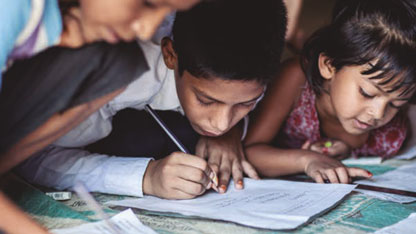
When a crisis strikes and everything is disrupted, education is often the first thing to be suspended and the last thing to be restored. However, the right to education is inalienable and must therefore be guaranteed.
SITUATION
Worldwide, 78 million children are missing out on education because of crises and emergencies. In protracted crises, entire generations are left without education or protection.
IN EMERGENCIES, EDUCATION COMES TO A HALT

222 MILLION
children live in humanitarian crisis contexts.

1 IN EVERY 5
children live in countries affected by conflict.

69 MILLION
of girls living in emergency contexts are out of school.
EDUCATION SAVES LIVES
In a humanitarian emergency, education must be prioritised for children’s wellbeing. Not only does it ensure that children continue to learn, but it also provides them with a safe space away from dangers such as trafficking, labour exploitation, forced marriages and recruitment as soldiers. It allows them to play and socialise with their peers.

In crisis contexts, education is not perceived as important because it does not compromise children’s survival, like food or medical care, but without it, children are deprived of a key right and a basic tool for building their future.
Guaranteeing children’s right to education is essential, especially in places affected by war, crisis and conflict. Without education we cannot build a just and equitable society. Education cannot stop because it is an urgent right, it saves lives and provides a better future.
EDUCATION IN EMERGENCIES CANNOT STOP BECAUSE:
1
It heals: during conflict, it offers normality, routine, stability and hope.
2
It protects: it reduces the likelihood of children being sexually or economically exploited or recruited by violent groups.
3
It empowers: it helps them acquire skills such as leadership, self-sufficiency and resilience, and promotes entrepreneurship.
4
It is always an urgent right that cannot be interrupted. Without education, children affected by an emergency find it harder to cope.
EDUCO’S ROLE IN EDUCATION IN EMERGENCIES
In the last four years, our Education in Emergencies projects have supported 125,000 children and adolescents affected by humanitarian crises from Latin America to Asia via sub-Saharan Africa and Europe.

How does Educo guarantee education despite the emergency situation?

We accompany children and young people, as well as teachers, to care for and preserve their mental health.
We guarantee access to school or education to prevent children from working or being recruited by traffickers.
We offer alternative ways of continuing education, either through the internet or through channels such as radio.
We offer training to communities at risk of a natural disaster or conflict so that they know what to do or how best to react to the emergency.
We work to ensure that children not only have access to school, but that they receive a quality education, which is why we train teachers and adapt to the needs of each child.
We accompany both children and their families to help them overcome crises.
In host communities, we promote peace and dialogue, inclusion, tolerance and conflict resolution to strengthen social cohesion and contribute to long-term reconstruction processes.

“Education is my lifeline right now. I think I would fall apart if I couldn’t go to school”.
OXANA,
a 13-year-old girl affected by the war in Ukraine.
MORE FUNDS NEEDED
In all humanitarian crises, children really suffer. Many of their rights are violated, especially the right to education. However, only 3% of humanitarian funding is earmarked for education in emergency contexts.
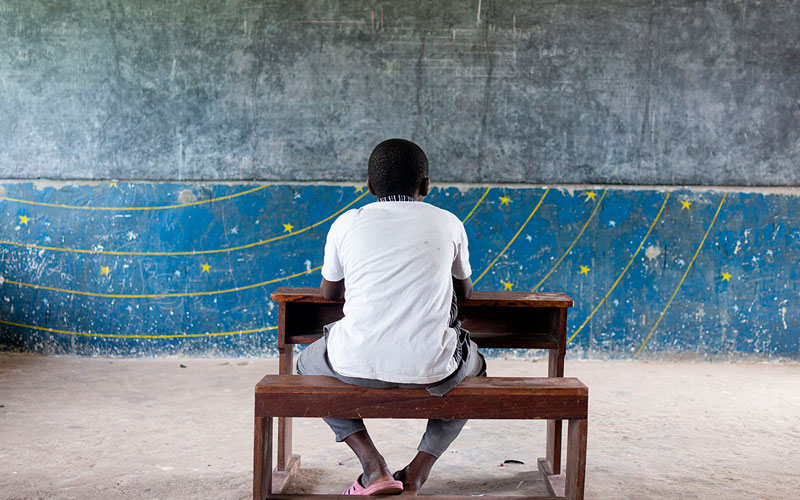
We call on the government to increase its funding for education in emergencies:
Funding for education in emergencies must be increased to 10% of humanitarian aid.
Funding for education must be increased to at least 8% of Official Development Assistance (ODA).
Between 2008 and 2018, Spain cut 80% of its official development assistance allocated to education. There is an urgent need to stop neglecting education in emergencies.
“My parents lost everything, and I didn’t go to school anymore because armed terrorist groups closed our schools.”
AISSATA,
a 9-year-old girl who had to flee from terrorist groups in Mali.
FIND OUT MORE
Read our publications about Education in Emergencies.